Thursday, July 03, 2014

XenServer Creedence Alpha 2, Disk Performance


360is gets paid to make information technology go faster.

Sometimes its hardware which doesn't hit the stated performance, or software which cant fully utilise the capability of modern hardware. Sometimes it's a lifetime extension for an old platform, squeezing in another 18 months growth before a replacement arrives. If we are really lucky we get to re-design an entire end-to-end process and make it more efficient. More layers and more abstraction means more scope for performance problems, so virtualisation has been a rich seam for us. With Citrix release of XenServer Creedence Alpha 2 (XSCA2) should we be worried? Is it time to throw in the towel on IT performance-tuning and setup that high-end bicycle-shop-come-espresso-bar we've always talked about?

We've been following XenServer performance from the start, and have a tome of magic spells to instrument and improve network, storage, and CPU performance. Without resorting to black-magic we were interested in seeing how XSCA2 performed straight out of the box.

Firstly let me say that all we have time for here is the most superficial of testing. Large sequential reads and writes are the 0-60 time of the storage world. That is to say, while they have some value, unless your use-case is an out-and-out drag race this test probably isn't a good approximation of the kind of performance you will see in your applications. Single VM large sequential read/writes are even more of a corner-case. If you only had a single VM to run you should probably run physical, just a suggestion...

Secondly, XSCA2 is alpha, and so it is slightly unfair subjecting it to a performance benchmark.

Finally, we used the equipment we had spare in the lab at the time. The storage back-end is puny. We had a handful of 10Krpm spindles and SSDs laying about. Out in the real world, 360is regularly deliver 1.5GB/sec to 2GB/sec of storage bandwidth (at high IOPS) to Hypervisors and physicals of one kind or another either over local or network storage.


The Goal
We were interested to see how XSCA2 performed against XenServer 6.2, against physical, and against "Brand-X" Hypervisor, all of which were "out of the box".

The Test
The test couldn't have been simpler. For a 2 vCPU VM, for each of 9 record sizes (64KB-16MB), we write (or read) 8GB of data and measure the performance in MB/sec for each record size. Why 2 vCPUs? Adding more doesn't change the results. Why 8GB? We can be sure 8GB blows through any caching that may be happening on disks, RAID controller, VM, or Hypervisor. Even at a 16MB record size, 8GB takes a lot of writes. For the physical test case we force direct IO to get around the fact that the physical system has much more RAM than 8GB. We use the same guest Operating System, installed in the same way for each of the VM tests. Everything is thick provisioned. This isn't a test of how fast each configuration can be made to go, it is a test of how fast each actually goes, straight out of the box on the lab system that was available at the time.

Tuning
None. No changes to the default install of XenServer, Brand-X Hypervisor, the CentOS VM or physical instance, with the exception of taking XSCA2 out of debug mode. No CPU pinning, no IO scheduler changes, no disk/virtual disk alignment, no IRQ balancing, no interrupt coalescing, no filesystem tweaking, no queue size alteration, no waving of dead chickens or reciting of incantations.

Results  
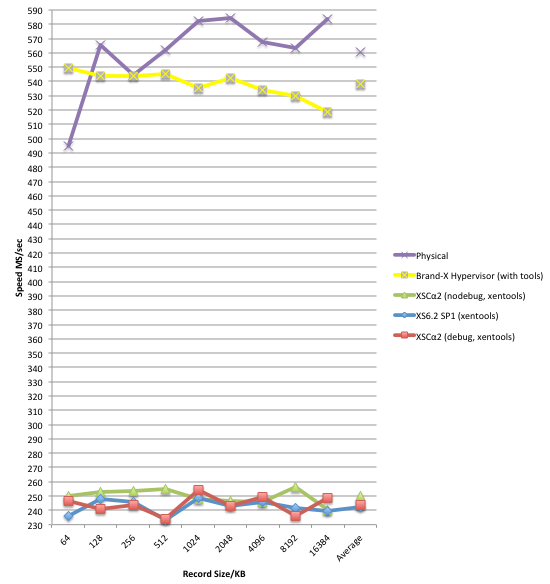
Enough talk, on with the results:

8GB Sequential Write At A Variety Of Record Sizes
8GB Streaming Write At A Variety Of Record Sizes


8GB Streaming Read At A Variety Of Record Sizes


On this system, for this test, XSCA2 is an improvement over XS61-SP1, but is still significantly behind the physical, and more disappointingly behind the other well known brand of Hypervisor. Besides the obvious, there are a few points from the chart which warrant further investigation for starters:
  • High jitter in all XS results.
  • Odd dip at the 512KB record size test on both XSCA2 and "Brand-X" hypervisor.
  • Slow start to the physical test at 64KB record size.
  The tests shown here were on a RAID0 of 3x 10Krpm spindles (maximum sustained transfer rate ~200MB/s each). Conducting the same test on a RAID0 of SSDs made little difference to the XenServer results, adding 20MB/s to the average write result and 40MB/s to the average read value.

Conclusions
  1. We aren't out of the performance tuning business just yet it seems!
  2. There is a significant difference in performance between the physical and "Brand-X" and XenServer.
  3. Read performance is particularly disappointing for XenServer in this test.

"It is easier to repair a bucket with a big hole, than an inner tube with a slow puncture." - Ancient 360is Engineer's Proverb.

For this system, for this test, the hole in the bucket is large, with a bit of further investigation it shouldn't be too hard to find. XenServer Dom0 (which strictly speaking we don't care about) comfortably achieves ~600MB/sec in read performance tested using "dd" with direct IO (no cache effect), so we know the problem is with the guest disk virtualisation IO path. First port of call will be instrumenting CPU consumption in the guest and Dom0, paying particular attention to XSCA2 susceptibility to numa-effects on the CPUs. We love a mystery. The game is afoot!


Further Information
Test VM Spec.
CentOS6 x86_64 Linux, default install from distribution, updated with "yum update" 3-07-2014, with the following additional packages: wget, openssh-clients, iozone (3.424-2 x86_64). 2 vCPUs, 1GB RAM, 20GB virtual hard disk.
Test Hardware Spec.
AMD 6176 CPUs (x2), 192GB 1066MHz RAM, LSI 9260-4i RAID, 3x WD1000DHTZ, 2x SSDSC2BW12.
Test Hardware OS.
CentOS6 x86_64 (same as VMs).
Brand-X Hypervisor.
Latest version, chose the PV SCSI device.

Benchmark.
We used the continuous benchmarking feature of VMCo Virtual Estate Manager (VEM). VEM's benchmarking alerts administrators to performance regressions in your XenServer or VMware estate, whether they be caused by bugs, patches, hardware problems, subtle interactions between network elements or administrator misconfiguration. VEM's continuous benchmarking shows you where the performance regression is, when it started, and it's impact is.


Tuesday, June 03, 2014

Disaster Recovery Rehearsals, A Guide To Avoiding Failure

SRA command 'testFailoverStart' failed for device '/vol/'
Who left the tap on?

How confident are you that if or when you need to enact your IT Disaster Recovery (DR) process, you will meet or exceed the expectations of management,  customers, and shareholders?

Someone, somewhere, is in the middle of a disaster right now. It happens to every day. Yet even though the price and effort-cost of providing DR has shrunk over the last 20 years, many organisations, even large and well-funded ones, continue to fail at DR. Perhaps part of the problem is the word disaster, we hear about disasters daily; typhoons, earthquakes, tsunami, reactor melt-down, pandemics, civil war. These things seem pretty remote to the inhabitants of London's Old Street or The City. What about a fire? Or a burst Victorian water pipe? Or perhaps a small construction accident? What about a malicious mouse click by an irked systems administrator? Most IT disasters do not make good candidates for Hollywood movies,  this doesn't mean they don't happen.

To download our guide to the 7 most common reasons for failure of DR exercises, skip down to the end of this posting.

360is consultants recently took part in a Disaster Recovery (DR) exercise for large London-based multi-national client. While nothing about the exercise was particularly new or remarkable, it serves as a reminder that even meticulously planned Disaster Recovery rehearsals can still hit snags on the day. We thought we'd share with you part of the briefing we gave to our client before the day of the test so that you and your organisation may be better prepared for those unforeseeable problems.


The Project Goals
  • Work through a failover of all applications, public network connections, and user remote access from the primary site to the DR site.
  • The end user's team to complete a battery of tests to determine the level of functionality at the DR site.
  • The entire exercise was to be conducted over the weekend, everything needs to be back to normal for monday morning.
  • As the client operates an international business working around-the-clock, real users need to be able to continue working on the primary site without any disturbance during the exercise.
  • At the end of the exercise the DR site workloads and data are to be destroyed, or rather reset to the previous position before the DR exercise began.

The Risk Factors
  • The client scheduled the test for the day of a major national event during which most major roads in London are closed.
  • 50% of previous rehearsals had problems which halted the exercise and caused it to be abandoned.
  • There was a tight time window given the number of workloads, acceptance testing, and the need to get everything back to the start positions for monday.
  • The technologies used were well known but complex, and not without their own quirks/bugs.
  • 360is ultimately had only 36 hours notice of the project and no prior involvement in building any of the infrastructure.
  • People from 3 organisations across 4 physical locations would be required to take part in the exercise.

The Outcome
While the client's data was never endangered, this project was a relatively high risk one given the factors above. Although minor snags were encountered during the test, these were quickly overcome using our specialist product knowledge and multi-vendor experience across the technologies involved. The total test duration was approximately 15 hours wall-clock time, with 1 out of 200 workloads failing to come up satisfactorily. The exercise was pronounced a success by the client.


So why was the exercise a success this time compared to previous failures?

Success Factors
There were 3 reasons why this exercise was a success this time around versus previous attempts.
  • Preparation
Through previous exercises, the team had carried out a relatively high degree of preparation. The order of events was well rehearsed (and documented) and everyone had a clear view of their own responsibilities. Checkpoints were established, estimations of how long each of the 20+ phases would take were relatively accurate.
  •  Automation
A high degree of automation was achieved using the virtualisation and storage platforms available. In fact the only significant snag was due to a small part of the replication process which someone had implemented manually long-ago, rather than leaving it up to the automated mechanism.
  • Availability of Expertise
No matter how well prepared you are every complex DR rehearsal will encounter some problems on the day. Whether it be a bug in software, an oversight in the procedure, or simply something that was not anticipated because full-scale testing was never done. When this happens there is no time to open a call with the vendor, or wade through Internet forums, or build a test rig, you need expertise in the room, on the phone, there and then. This is the area where 360is was able to intercede and directly influence the outcome of this project. Once a partial failure had been reported, we were able to provide our client with an explanation of what had gone wrong, why, what the significance was to the rest of the test, and what to do about it to prevent this becoming another aborted test.

360is Consultancy Engagement Profile

Duration:
  • 3-man days including preparatory project management meeting.

The Client:
  • A division of the one of the Big 4 audit firms, approximately 200 production workloads.

The Team:
  • Client: System Administrator, Project Manager, Offshore Application Testing Team, Programme Director.
  • Service Provider: Network, Security, Project Manager, System Administrator, not forgetting the NOC.
  • 360is: 1x Senior Consultant and 1x VMware Specialist.

The Technologies
  • NetApp (storage and replication)
  • VMware (Site Recovery Manager)
  • Juniper & Cisco (BGP routing & security)
  • Data centres operator facilities in east and west London

360is Guide To Avoiding Failure In Disaster Recovery
At some point or other we end up issuing the following guidance memo to all of our clients embarking on either building a DR infrastructure or conducting a DR rehearsal. It applies to all OS and application vendors, and all network or storage products, and while most of our clients are wholly or largely virtualised it also applies to non-virtual environments. To learn how to avoid the 7 most popular causes of failure in Disaster Recovery exercises, download the PDF [74KB].

Monday, April 28, 2014

360is at Infosecurity Europe 2014

London Underground Backup Plan

Three Sixty Information Security Ltd will again be at Earls Court, London for the Infosecurity Europe show, 29th April to 1st May 2014. We'll be meeting clients, partners, and friends among the 12000 expected visitors and 329 stands at the show this year.

If you want to discuss the results of a penetration test, arrange a confidential meeting about a  breach, or just need advice on how your organisation should handle the OpenSSL Heartbleed bug, get in touch. We will have technical consultants at the show.

London Underground are still running a District Line service during the 48 hour tube strike, but remember you can always take a bus!

Tuesday, June 18, 2013

A Quick Enumeration Of The PRISM Program

Enumeration of PRISM
As IT security consultants, former representatives at the GSMA, contributors to IETF's "Raven", and one-time employes of the worlds largest ISP, the inevitable questions started coming up in meetings and conversations shortly after the 8th June.


"...two reporters from the Guardian newspaper announced to the world the source of one of the most significant classified-document leaks in history. Edward Snowden, a 29-year-old national-security contractor from Hawaii, revealed that he was compelled by conscience to inform the world about a massive abuse of authority perpetrated by the US National Security Agency. According to the documents Snowden provided, which have been authenticated, the US government has been systematically collecting the phone records and online communications of millions of American citizens for years."

Clients, commentators, and friends all want answers to the same questions:
  1. What are the NSA doing, and how are they doing it?
  2. What does this mean for IT security?
  3. Where does this go next?

While we can expect this story to develop over many months as more information is dripped out,  we can already go some way towards answering question (1). See the 360is enumeration of PRISM possibilities. PDF.

Where will the story go next? That this story will run and run is something of which we can be sure. It has elements of Manning/Wikileaks (an ethically conflicted individual with access to state secrets), of Leeson/Barings (a young man, on the run from authorities in a foreign land), and just enough direct relevance to UK readers through glimpses into the actions our own GCHQ, who are normally more publicity shy than their US counterparts. The UK intelligence services have been relatively fortunate in recent years, suffering  few leaks, disgruntled former employees, or clumsiness. This episode illustrates both the frequency and extent to which intelligence sharing occurs between the UK and US and the fact that occurrences such as the Snowden event can have an impact for both services with unintended consequences that cannot be anticipated easily.

Timing is everything,  the publication of these revelations may have some bearing on future of The Draft Communications Data Bill or "Snoopers Charter" as it is commonly known. With well publicised recent convictions of a number of terrorist individuals and groups, significant good-will had been earned among the UK public. Any poor handling of the existing Snowden disclosures, and further leaks that are yet to come, may diminish this good-will and make introduction of such a bill more difficult in the future. Futhermore, the disclosure of GCHQ's activities around the 2009 G20 summit in London is bound to have an impact at the G8 event currently in-progress in Northern Ireland.

Looking further out, companies and individuals in Europe may seek to engage with services and providers that do not come directly under US law. Apple, Microsoft, and FaceBook (3 out of many providers) have stated that they handed over data from 10000, 32000, and 19000 accounts respectively in 7 months. US cloud providers are already having trouble persuading European enterprise customers that their sensitive (but completely legal) data is safe from US government spying. This leak will only make matters worse. As one journalist put it "Not subject to American law' - the next desirable IT feature?"

All that we need now is a catchy name for this episode. Dotcomgate? igate? How about "Cloudgate"?

360is will be presenting further analysis of "Cloudgate"and advice for UK organisations in the next edition of Executive Intelligence, our quarterly for UK CSOs and Information Security Managers.

Related Postings:
WikiLeak's Lessons For UK Information Security Professionals.

Update Saturday 8 June 2013 18.56 BST: Leaked NSA slides confirm, PRISM includes direct monitoring of fiber cables and collection directly from the servers of MS, Yahoo, Google, and Co.

Monday, November 12, 2012

Higher Hard Drive Prices, Still The New Normal

About 7 months ago, back at the end of Q1 2012 we researched hard drive prices and compared them to pre-flood levels. We concluded that higher prices would be here to stay for the next few years for a couple of reasons:
  • Nobody is investing in next-generation facilities with only 2 serious players in the spinning rust market, there is no need reduce manufacturing cost in the medium term with next generation factories or processes.
  • A lot of the specialist tools and precision equipment used for testing and building hard drives are no-longer available. The firms that made them have long since gone bust as the market consolidated in the last 15 years. Lack of such equipment is a barrier to increasing production and (re)building plants.
  • While Solid State Disks continue to march into mobile, desktop, and enterprise storage, the bulk of new added capacity will continue to be provided by spinning disks. In the enterprise data centre they form either a thin tier or are deployed tactically to take care of IOPS/latency hot-spots. Hard disks in the enterprise are not about to be wiped out by SSD storage.
The bad news is that the majority of drives are still more expensive now than pre-flood. Some are around 60-70% more expensive than pre-flood levels.

If your organisation or project is hamstrung by storage costs or performance, talk to us. We have helped companies in Finance, Life Science, Academic, and Software sectors accomplish and exceed their goals, on-time and on-budget, in spite of rising storage costs. Get in touch to find out how.